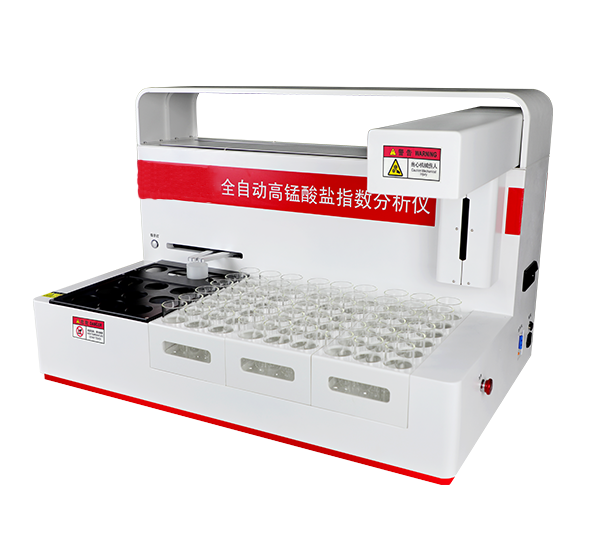
5032 5032 Fully Automatic Permanganate Index Analyzer
Overview
Water quality monitoring divides into laboratory determination and field sampling, and the requirements are different in kind. Laboratory analysers prioritise accuracy, reagent economy and unattended throughput. Field systems prioritise how well they survive and how little they need servicing between deployments.
Key specifications — 5032
| Parameter | Specification |
|---|---|
| Model | 5032 |
| Product type | 全自动高锰酸盐指数分析仪 |
| 54 sample positions, 9-position digestion | 54 sample positions, 9-position digestion |
| Precision RSD <=3.0% at 3.0 mg/L (n=3) | Precision RSD <=3.0% at 3.0 mg/L (n=3) |
| Range (0~6.0) mg/L | Range (0~6.0) mg/L |
| Min volume 0.02 mL | Min volume 0.02 mL |
| Detection limit 0.05 mg/L | Detection limit 0.05 mg/L |
| <=4 min per sample | <=4 min per sample |
| Temp control +/-1C | Temp control +/-1C |
| <2000 W | <2000 W |
Standards
GB/T 5750.7-2023 · GB 11892-89
Applications
Surface water and drinking water networks · wastewater treatment plant influent and effluent · industrial effluent monitoring · precipitation and acid deposition sampling · groundwater monitoring · marine and coastal surveys · drinking water source protection
Configuration
Measurement range, sampling flow, probe type, gas configuration, output protocol and data storage are specified at order. State your requirement and we will confirm the configuration in the quotation.
Frequently asked questions
CODcr or permanganate index — which should I use?
They measure different things and are not interchangeable. CODcr is the dichromate oxidation method and remains the regulatory method for most wastewater permits; it takes roughly 30 minutes and consumes significant reagent. The permanganate index (COKMn) oxidises more weakly but costs far less, runs much faster, and is widely used for surface water and drinking water monitoring where high COD is not expected. If your permit names a specific method, that method governs.
How much reagent does an automatic COD analyser consume?
Substantially less than manual analysis, because the instrument doses only what the sample requires rather than a fixed excess, and it performs the blank determination itself. Running unattended over a programme of samples is where the savings compound. Ask for the reagent consumption figure for your own duty cycle rather than accepting a generic figure — the honest number depends on sample range and frequency.
Can these instruments run unattended outdoors?
The automatic analysers are typically installed indoors in a controlled environment where temperature and reagent storage are controllable, which is normal practice. The field-deployable systems — the 5008B suction filter at IP56, the 5020 precipitation sampler with a thermostatically controlled cabinet, and the 5040 autonomous vessel with IP68 sensors — are designed for continuous outdoor deployment.
Request a quotation
Send the application, the parameter or gas, the measurement range, the output protocol required and your target delivery date. An engineer will reply with a configuration recommendation and a price — normally within one working day.
Model: 5032 | Required options: ____________ | Output protocol: ____________ | Target delivery: ____________