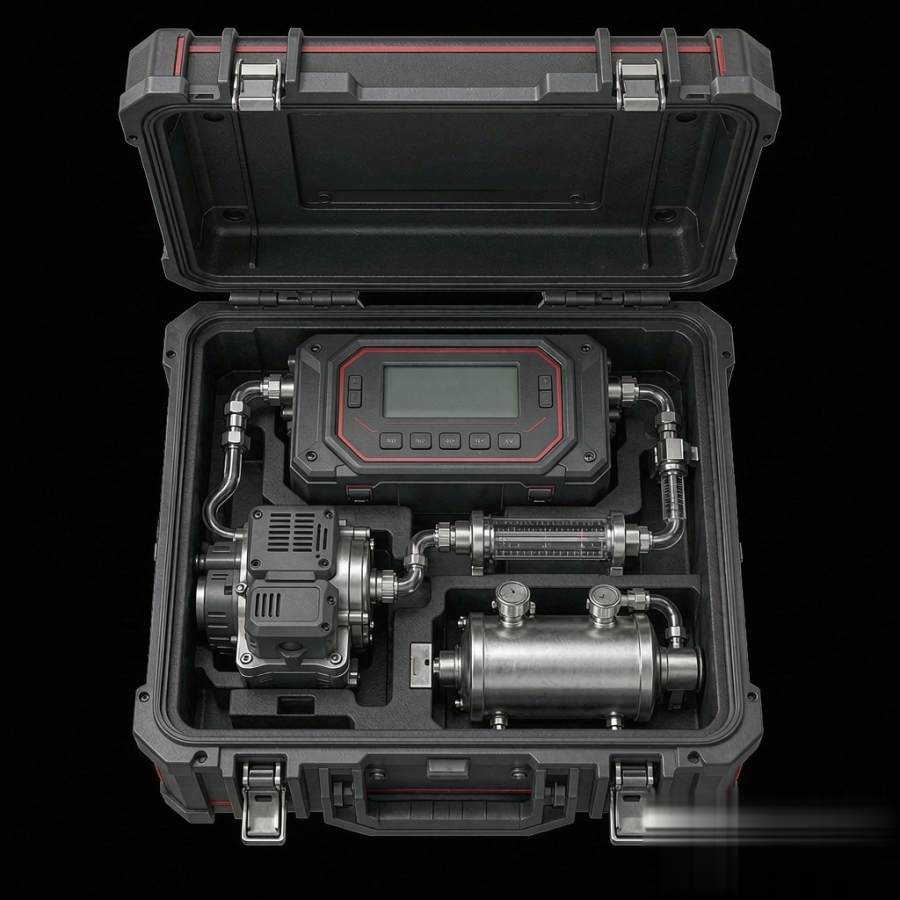
Overview
Volatile organic compounds are among the most stringently regulated pollutants worldwide, and measurement differs substantially by application. Ambient air capture, stack gas sampling, fuel vapour recovery and leak screening require different sampling media, flow rates and analysis principles. kesense covers all four.
Key specifications — 3038C
| Parameter | Specification |
|---|---|
| Model | 3038C |
| Product type | All-in-One Exhaust VOCs Sampling Instrument |
| Flow rate | Flow (10~200) mL/min sealed, customisable to (0.2~2) L/min |
| Heating temperature | Heating 120C (80~160 optional) |
| Sampling time | Sampling time to 99 h 59 min |
| Back pressure | Back-pressure >20 kPa |
| Weight | 3.5 kg |
| Supply voltage | DC24V/10A |
Measurement conditions
- Reference temperature — 25 °C ambient unless a row states otherwise
- Reference pressure — 101.3 kPa
- Humidity — non-condensing
- Response time — T90 as stated per configuration
Range, compensation mode, gas and response time are confirmed per configuration at order. Every figure above is tied to its stated condition — ask us for the exact reference behind any number.
Standards
GB/T 16157-1996 · HJ/T 47-1997 · HJ/T 734-2014 · JJG 1169-2019
Applications
Petrochemical and chemical plants · fuel terminals and tank farms · petroleum loading terminals · industrial coating and printing · solvent recovery · LDAR programmes · waste incineration · landfill and wastewater treatment
Configuration
Measurement range, sampling flow, probe type, gas configuration, output protocol and data storage are specified at order. State your requirement and we will confirm the configuration in the quotation.
Frequently asked questions
Which measurement principle should I choose?
It depends on what you are measuring. Flame ionisation detection (FID) gives total hydrocarbon response and is the reference method for many regulatory applications. Photoionisation detection (PID) responds to a wide range of VOCs at low concentration and is the usual choice for leak screening and indoor air. Photoacoustic infrared gives selective measurement of individual compounds at ppm level without consumables. Our 3033 accepts both FID and PID so one instrument covers both tasks.
What sampling media do I need?
Sorbent tube sampling is the standard for ambient air and requires thermal desorption analysis. Solution absorption suits high-boiling and polar compounds. Canister and bag sampling capture the full volume for subsequent laboratory analysis. The 2061 supports both sorbent tube and solution absorption; the 3036 and 3038C use canister and bag methods. Tell us your target compounds and the method your report must follow, and we will specify the correct train.
Can these instruments be used in hazardous areas?
Intrinsic safety matters here. Models 2026 and 3062 are designed and certified to GB 3836.1 and GB 3836.4, which align with the IECEx scheme; the 3233 gas leak thermal imager carries Ex ia IIC T4 Ga. For European ATEX certification, state your requirement in the enquiry and we will confirm what can be provided.
Request a quotation
Send the application, the parameter or gas, the measurement range, the output protocol required and your target delivery date. An engineer will reply with a configuration recommendation and a price — normally within one working day.
Model: 3038C | Required options: ____________ | Output protocol: ____________ | Target delivery: ____________